Why do I feel lonely even though I have friends?
At the birthday dinner you laughed in all the right places and still felt you weren’t there. Where that comes from, and what helps.
The short answer
Loneliness is about how close you feel to people, and that can be far from how many people you see. A busy diary doesn’t rule it out. What’s often missing is one or two people who know you well, seen often enough for that closeness to grow.
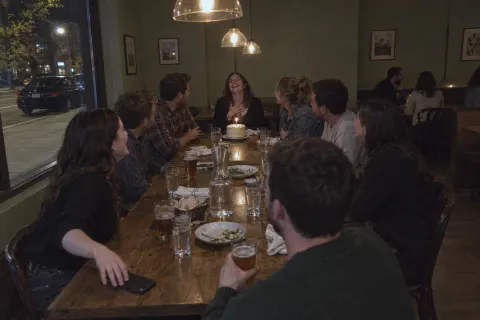
You’ve just come home from a birthday dinner. Eight of you squeezed round two tables pushed together, somebody’s cousin told a long story about a missed ferry, and you laughed in all the right places. Nobody was unkind to you. Then you shut the front door, and an odd emptiness settles in, as if you’d missed your own evening. You could have sent a cardboard cut-out and nobody would have asked for the real one.
Two American loneliness researchers describe it as feeling cut off from people, and that can happen while you’re surrounded by them. You can have a full social life on paper and still feel lonely, they wrote, because what counts is “the quantity or especially the quality” of your relationships.1
England’s yearly Community Life Survey shows how common this is. In 2024 to 2025, 95 in 100 adults said they had at least one person who would listen when they needed to talk. Yet about 7 in 100 felt lonely often or always.2 Having people around and feeling close to them are not the same thing.
Researchers have long split loneliness into two kinds, and the split helps if you’re the one who left that birthday table feeling empty. The first kind is an empty feeling of missing someone really close to you. The second is having too few people around whom you feel connected to, trust and could fall back on.3 You can have one without the other, and they point to different fixes.
Which of these sounds like you?
- You’re part of a group, but the talk never really reaches you
- Lonely next to your partner
- Late-night thoughts about your friends
- You’ve moved, or a relationship has ended
- Your old friends are still friends, just far away
You’re part of a group, but the talk never really reaches you
Groups are good at some things and bad at others. A table of eight is great for jokes, shared stories and the warm noise of everyone talking at once. It’s close to hopeless for the question “how are you, actually?”, because nobody asks it in front of seven other people, and nobody answers it truthfully if they do.
So you can enjoy your crowd and still go home hungry.
If this is you, keep the group: it gives you the wider kind of closeness, and that’s worth having. Add a second, smaller setting next to it. Pick the one person at the table you’d most like to know better, and ask them to do something with just you.

Lonely next to your partner
You might share a kitchen, a bed and a calendar with someone and still feel alone some evenings. A partner often covers the first kind of loneliness, the missing of one close person, and does much less for the second.3
That is why couples with young children can feel cut off even with someone beside them: the close bond is there, while friends, neighbours and colleagues have quietly dropped away.
The two gaps feel alike from the inside and lead in different directions. If you miss a wider circle, your relationship may be fine, and the fix is friends, neighbours or colleagues. If you miss closeness while lying next to someone, say so to them in plain words, early.
Late-night thoughts about your friends
A two-word reply from a friend, read on the sofa after a quiet evening on your own, can look like a verdict on you. The same message in your lunch break, between work and errands, would read as someone busy.
Loneliness can tilt how you read people. Lonely people tend to expect others to be less friendly than they turn out to be, and to see the social world as more threatening than it is.1 If your worst thoughts about friends tend to come after dark, notice the hour, and leave any decision about whether people like you until the next day.
You’ve moved, or a relationship has ended
Starting over in a new place is lonely because friendship takes hours, and you haven’t had them yet. A friendship researcher in Kansas asked hundreds of adults who had just moved, and later a group of new university students, how their friendships formed. More hours together went with closer friendships.4
He also put rough numbers on it. Going from someone you know to a casual friend took about 50 hours together. A real friend took about 90 hours, and a close friend more than 200 hours.5 At two hours a week with someone new, that’s about six months to a casual friend and about two years to a close one.
A breakup can hit the same sum from the other side. If your partner was where most of your spare hours went, the split takes all of those hours at once. On those numbers, friends you saw less of during the relationship will need some of those hours back. Book time with people now, before you feel ready for it.
Your old friends are still friends, just far away
Maybe your best friends live in another city, or on another schedule, or in a life with small children that leaves room for a voice note every few weeks. On paper the friendship is as strong as ever, and you’d still call them first if something went badly wrong.
That study was about making friends, so it can’t say exactly how friendships fade. In the same surveys, the people who spent more fun time together, hanging out and joking around, tended to feel closer, and hours spent working together didn’t count as much.5 On that reasoning, a shared past alone may not keep a friend close if you only talk twice a year.
Pick a fixed weekly slot for a call with a far-away friend, so it doesn’t need arranging each time.
Lonelier than ever? The long-run numbers are calmer than the headlines
You may have read that we’re living through a loneliness epidemic. The long-run data is much calmer. A review of surveys from 113 countries found that loneliness varies a lot by place and age, and said there isn’t enough data to tell whether it’s rising.6 Between 2005 and 2016, two large surveys of older adults in the United States found no rise.7
England’s own yearly survey shows a small rise, not a sudden jump. From 2013 to 2022, about 5 or 6 in 100 adults felt lonely often or always each year. In 2024 to 2025 it was about 7 in 100, a little lower than the year before.2
Why the hours once added up by themselves
For about 95 out of every 100 years our species has existed, humans lived by hunting and gathering. A team of anthropologists looked at 32 groups who still live this way. A typical camp held about 28 adults, and most of them were not related to each other. In a camp like that, the 200 hours a close friend needs pile up without anyone planning them. These were groups alive in recent decades, so they show how a foraging life can work today.8 What camps looked like 50,000 years ago can only be pieced together.
One of the researchers quoted near the top thought this may be why loneliness exists at all. With two colleagues he argued that it may have evolved as an unpleasant feeling that, like hunger, thirst and pain, pushes us to change what we’re doing, in this case back towards people.9 It’s a theory, and a hard one to test. If it’s right, the empty feeling after that dinner is a push to spend more time with someone.
About 5, then about 15, then a few dozen: that’s how people’s groups seemed to stack up when a team pooled many older studies of group sizes.10 The inner 5 are roughly the people you’d tell first if you got bad news, or drop in on without needing a reason. A phone full of contacts fills the outer layers easily. If you feel lonely with friends, the inner circle is the first place to look.
How many people could you ring this week just to talk, with no reason needed?
Pick the one that fits you.
If you’d like to map your other circles too, draw your circle of friends. It takes about three minutes.
One friend seen weekly beats five seen once
Across nearly 150 studies, people with stronger social ties were more likely to still be alive years later.11 Studies like these can’t fully prove which causes which, so read it as a nudge to take friendship seriously.
- Pick one person and put them in your week, every week. In the Kansas studies, closeness grew with hours spent together, so one friend seen weekly gets far more of them than five friends seen once each.4
- Choose time that’s just for fun. Hanging out and joking around went with feeling closer, while hours spent working together didn’t count as much. A walk beats a shared project.
- Do the inviting. As the Kansas researcher put it: “You can’t make people spend time with you, but you can invite them.”5
- Go smaller. If groups leave you empty, swap one group evening a month for a one-to-one. If groups simply leave you drained, the introvert or extrovert test shows how much company you tend to want before you need a rest.
- Check how you’re reading people. In the few proper trials so far, helping lonely people notice their own gloomy guesses, such as expecting people to be less friendly than they are, worked better than simply giving them more contact. There were only four such trials, so treat it as an early clue.1
If you’ve always felt lonelier than others
Some people feel lonelier than others whatever their diary looks like. Studies of twins link about half of the differences between people in how lonely they feel to their genes.9 So if you’ve always felt lonelier than the people around you, part of that may be how you’re built, not something you’re doing wrong with your friends. The steps above still help. They may just take longer to feel.
Sources (11)
- Hawkley, L. C., and Cacioppo, J. T. (2010). Loneliness matters: a theoretical and empirical review of consequences and mechanisms. Annals of Behavioral Medicine, 40(2), 218-227. Read the study Back to the text
- Department for Culture, Media and Sport (2026). Community Life Survey 2024/25: loneliness and support networks. Official statistics for England: 6.6% of adults lonely often or always; 95% have at least one person to listen. www.gov.uk Back to the text
- Weiss, R. S. (1973). Loneliness: The experience of emotional and social isolation. Cambridge, MA: MIT Press. The split into emotional and social loneliness. Back to the text
- Hall, J. A. (2019). How many hours does it take to make a friend? Journal of Social and Personal Relationships, 36(4), 1278-1296. Read the study Back to the text
- University of Kansas (2018). How to make friends? Study reveals how many hours it takes. News release on Hall’s study. news.ku.edu Back to the text
- Surkalim, D. L., Luo, M., Eres, R., and others (2022). The prevalence of loneliness across 113 countries: systematic review and meta-analysis. BMJ, 376, e067068. Read the study Back to the text
- Hawkley, L. C., Wroblewski, K., Kaiser, T., Luhmann, M., and Schumm, L. P. (2019). Are U.S. older adults getting lonelier? Age, period, and cohort differences. Psychology and Aging, 34(8), 1144-1157. Read the study Back to the text
- Hill, K. R., Walker, R. S., Bozicevic, M., and others (2011). Co-residence patterns in hunter-gatherer societies show unique human social structure. Science, 331(6022), 1286-1289. Read the study Back to the text
- Cacioppo, J. T., Cacioppo, S., and Boomsma, D. I. (2014). Evolutionary mechanisms for loneliness. Cognition and Emotion, 28(1), 3-21. Read the study Back to the text
- Zhou, W. X., Sornette, D., Hill, R. A., and Dunbar, R. I. M. (2005). Discrete hierarchical organization of social group sizes. Proceedings of the Royal Society B, 272(1561), 439-444. Read the study Back to the text
- Holt-Lunstad, J., Smith, T. B., and Layton, J. B. (2010). Social relationships and mortality risk: a meta-analytic review. PLoS Medicine, 7(7), e1000316. Read the study Back to the text
About these sources. A few figures come from published summaries, because the full papers are behind a paywall.


